

History Of The Forex Market How It All Began
The foreign substitution market (Forex, FX, or currency market) is a global decentralized or over-the-counter (OTC) market for the trading of currencies. This market determines foreign exchange rates for every currency. It includes all aspects of buying, selling and exchanging currencies at current or determined prices. In terms of trading volume, it is by far the largest market in the world, followed by the credit market.[ane]
The main participants in this market are the larger international banks. Financial centers around the world part equally anchors of trading betwixt a broad range of multiple types of buyers and sellers around the clock, with the exception of weekends. Since currencies are always traded in pairs, the foreign exchange market does not set a currency'south absolute value but rather determines its relative value by setting the market price of one currency if paid for with another. Ex: Usa$1 is worth 10 CAD, or CHF, or JPY, etc.
The foreign exchange market works through fiscal institutions and operates on several levels. Backside the scenes, banks plough to a smaller number of fiscal firms known as "dealers", who are involved in large quantities of foreign exchange trading. Most foreign exchange dealers are banks, and then this behind-the-scenes market is sometimes called the "interbank market place" (although a few insurance companies and other kinds of fiscal firms are involved). Trades between strange exchange dealers tin be very big, involving hundreds of millions of dollars. Because of the sovereignty issue when involving two currencies, Forex has niggling (if any) supervisory entity regulating its deportment.
The foreign commutation market assists international trade and investments past enabling currency conversion. For example, it permits a business in the United States to import appurtenances from European Wedlock member states, specially Eurozone members, and pay Euros, even though its income is in United States dollars. It also supports directly speculation and evaluation relative to the value of currencies and the carry trade speculation, based on the differential interest rate betwixt two currencies.[2]
In a typical foreign commutation transaction, a party purchases some quantity of 1 currency by paying with some quantity of another currency.
The modern foreign substitution market place began forming during the 1970s. This followed three decades of regime restrictions on foreign commutation transactions under the Bretton Forest arrangement of monetary direction, which set out the rules for commercial and financial relations among the world'south major industrial states afterward World State of war II. Countries gradually switched to floating exchange rates from the previous exchange rate regime, which remained fixed per the Bretton Woods system.
The strange exchange market is unique because of the following characteristics:
- its huge trading volume, representing the largest asset class in the world leading to high liquidity;
- its geographical dispersion;
- its continuous functioning: 24 hours a day except for weekends, i.e., trading from 22:00 GMT on Sunday (Sydney) until 22:00 GMT Friday (New York);
- the multifariousness of factors that touch exchange rates;
- the low margins of relative turn a profit compared with other markets of fixed income; and
- the utilise of leverage to enhance turn a profit and loss margins and with respect to business relationship size.
As such, information technology has been referred to as the market place closest to the ideal of perfect competition, yet currency intervention by central banks.
According to the Depository financial institution for International Settlements, the preliminary global results from the 2019 Triennial Central Banking company Survey of Foreign Substitution and OTC Derivatives Markets Activeness bear witness that trading in foreign exchange markets averaged $vi.6 trillion per day in April 2019. This is upwardly from $5.1 trillion in April 2016. Measured past value, foreign exchange swaps were traded more than whatever other instrument in Apr 2019, at $3.ii trillion per day, followed by spot trading at $2 trillion.[3]
The $6.6 trillion break-down is every bit follows:
- $2 trillion in spot transactions
- $ane trillion in outright forwards
- $3.2 trillion in foreign exchange swaps
- $108 billion currency swaps
- $294 billion in options and other products
History
Ancient
Currency trading and commutation beginning occurred in aboriginal times.[iv] Money-changers (people helping others to change money and also taking a commission or charging a fee) were living in the Holy State in the times of the Talmudic writings (Biblical times). These people (sometimes called "kollybistẻs") used city stalls, and at feast times the Temple's Court of the Gentiles instead.[5] Money-changers were too the silversmiths and/or goldsmiths[6] of more contempo ancient times.
During the 4th century Advertizement, the Byzantine government kept a monopoly on the substitution of currency.[seven]
Papyri PCZ I 59021 (c.259/8 BC), shows the occurrences of substitution of coinage in Ancient Egypt.[viii]
Currency and commutation were of import elements of trade in the ancient earth, enabling people to purchase and sell items like food, pottery, and raw materials.[ix] If a Greek coin held more than golden than an Egyptian money due to its size or content, then a merchant could barter fewer Greek aureate coins for more than Egyptian ones, or for more material goods. This is why, at some point in their history, most world currencies in circulation today had a value stock-still to a specific quantity of a recognized standard like argent and gold.
Medieval and later
During the 15th century, the Medici family were required to open banks at foreign locations in order to commutation currencies to act on behalf of textile merchants.[ten] [11] To facilitate trade, the banking concern created the nostro (from Italian, this translates to "ours") business relationship book which contained two columned entries showing amounts of foreign and local currencies; information pertaining to the keeping of an account with a foreign bank.[12] [13] [14] [xv] During the 17th (or 18th) century, Amsterdam maintained an active Forex market.[sixteen] In 1704, foreign commutation took place between agents interim in the interests of the Kingdom of England and the County of Kingdom of the netherlands.[17]
Early modern
Alex. Brownish & Sons traded foreign currencies around 1850 and was a leading currency trader in the Usa.[eighteen] In 1880, J.K. do Espírito Santo de Silva (Banco Espírito Santo) applied for and was given permission to appoint in a foreign exchange trading business.[19] [xx]
The year 1880 is considered by at least ane source to be the beginning of modern foreign substitution: the gilded standard began in that year.[21]
Prior to the First Earth War, there was a much more than express command of international trade. Motivated by the onset of state of war, countries abandoned the golden standard budgetary organisation.[22]
Modern to post-modern
From 1899 to 1913, holdings of countries' foreign substitution increased at an annual rate of 10.8%, while holdings of gold increased at an annual rate of vi.3% betwixt 1903 and 1913.[23]
At the terminate of 1913, almost half of the world'south foreign commutation was conducted using the pound sterling.[24] The number of foreign banks operating within the boundaries of London increased from 3 in 1860, to 71 in 1913. In 1902, there were but 2 London foreign exchange brokers.[25] At the start of the 20th century, trades in currencies was most active in Paris, New York Metropolis and Berlin; United kingdom remained largely uninvolved until 1914. Betwixt 1919 and 1922, the number of foreign exchange brokers in London increased to 17; and in 1924, there were 40 firms operating for the purposes of commutation.[26]
During the 1920s, the Kleinwort family were known as the leaders of the strange exchange market, while Japheth, Montagu & Co. and Seligman still warrant recognition as pregnant FX traders.[27] The trade in London began to resemble its modern manifestation. By 1928, Forex merchandise was integral to the financial functioning of the metropolis. Continental exchange controls, plus other factors in Europe and Latin America, hampered any attempt at wholesale prosperity from trade[ clarification needed ] for those of 1930s London.[28]
Later Globe War II
In 1944, the Bretton Woods Accord was signed, allowing currencies to fluctuate within a range of ±1% from the currency'south par exchange rate.[29] In Japan, the Foreign Exchange Bank Law was introduced in 1954. As a upshot, the Bank of Tokyo became a center of foreign exchange past September 1954. Between 1954 and 1959, Japanese law was changed to allow foreign substitution dealings in many more Western currencies.[xxx]
U.Due south. President, Richard Nixon is credited with ending the Bretton Woods Accord and fixed rates of exchange, somewhen resulting in a free-floating currency organisation. Subsequently the Accord ended in 1971,[31] the Smithsonian Agreement allowed rates to fluctuate by up to ±2%. In 1961–62, the volume of foreign operations past the U.Southward. Federal Reserve was relatively low.[32] [33] Those involved in controlling substitution rates found the boundaries of the Agreement were non realistic and so ceased this[ clarification needed ] in March 1973, when one-time afterward[ description needed ] none of the major currencies were maintained with a capacity for conversion to gold,[ clarification needed ] organizations relied instead on reserves of currency.[34] [35] From 1970 to 1973, the book of trading in the marketplace increased three-fold.[36] [37] [38] At some time (according to Gandolfo during February–March 1973) some of the markets were "split up", and a 2-tier currency market[ clarification needed ] was subsequently introduced, with dual currency rates. This was abolished in March 1974.[39] [40] [41]
Reuters introduced estimator monitors during June 1973, replacing the telephones and telex used previously for trading quotes.[42]
Markets close
Due to the ultimate ineffectiveness of the Bretton Woods Accord and the European Joint Float, the forex markets were forced to close[ clarification needed ] sometime during 1972 and March 1973.[43] The largest purchase of The states dollars in the history of 1976[ clarification needed ] was when the Westward High german government achieved an almost iii billion dollar conquering (a effigy is given as 2.75 billion in total by The Statesman: Volume 18 1974). This upshot indicated the impossibility of balancing of exchange rates by the measures of control used at the time, and the budgetary system and the strange exchange markets in West Germany and other countries within Europe closed for 2 weeks (during February and, or, March 1973. Giersch, Paqué, & Schmieding state closed afterwards buy of "7.5 million Dmarks" Brawley states "... Substitution markets had to be closed. When they re-opened ... March 1 " that is a big purchase occurred after the shut).[44] [45] [46] [47]
Afterwards 1973
In developed nations, state command of foreign exchange trading ended in 1973 when complete floating and relatively free market place conditions of modern times began.[48] Other sources merits that the first time a currency pair was traded by U.S. retail customers was during 1982, with additional currency pairs becoming available by the next yr.[49] [l]
On ane January 1981, every bit role of changes beginning during 1978, the People's Bank of China immune sure domestic "enterprises" to participate in foreign substitution trading.[51] [52] Sometime during 1981, the South Korean government ended Forex controls and allowed complimentary merchandise to occur for the first time. During 1988, the country'due south authorities accepted the IMF quota for international merchandise.[53]
Intervention past European banks (specially the Bundesbank) influenced the Forex market on 27 February 1985.[54] The greatest proportion of all trades worldwide during 1987 were within the United kingdom (slightly over one quarter). The United States had the 2nd highest involvement in trading.[55]
During 1991, Islamic republic of iran changed international agreements with some countries from oil-barter to strange commutation.[56]
Market size and liquidity
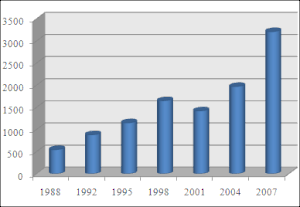
Chief foreign exchange market turnover, 1988–2007, measured in billions of USD.
The foreign exchange market place is the most liquid financial market in the world. Traders include governments and central banks, commercial banks, other institutional investors and fiscal institutions, currency speculators, other commercial corporations, and individuals. According to the 2019 Triennial Central Bank Survey, coordinated by the Bank for International Settlements, average daily turnover was $six.6 trillion in Apr 2019 (compared to $1.9 trillion in 2004).[3] Of this $6.6 trillion, $2 trillion was spot transactions and $four.six trillion was traded in outright forwards, swaps, and other derivatives.
Foreign exchange is traded in an over-the-counter market where brokers/dealers negotiate directly with 1 another, so at that place is no central substitution or clearing firm. The biggest geographic trading center is the United Kingdom, primarily London. In Apr 2019, trading in the Britain deemed for 43.1% of the total, making information technology past far the most important middle for foreign exchange trading in the earth. Attributable to London's authorisation in the market, a item currency'due south quoted price is usually the London market cost. For instance, when the International monetary fund calculates the value of its special drawing rights every twenty-four hour period, they utilize the London market prices at noon that day. Trading in the U.s. accounted for 16.five%, Singapore and Hong Kong account for seven.6% and Nippon accounted for 4.5%.[3]
Turnover of substitution-traded foreign exchange futures and options was growing chop-chop in 2004-2013, reaching $145 billion in Apr 2013 (double the turnover recorded in Apr 2007).[57] As of April 2019, exchange-traded currency derivatives represent 2% of OTC foreign substitution turnover. Foreign exchange futures contracts were introduced in 1972 at the Chicago Mercantile Exchange and are traded more than to most other futures contracts.
Most developed countries allow the trading of derivative products (such every bit futures and options on futures) on their exchanges. All these developed countries already have fully convertible capital accounts. Some governments of emerging markets exercise not allow foreign exchange derivative products on their exchanges considering they have capital controls. The use of derivatives is growing in many emerging economies.[58] Countries such as Due south Korea, Due south Africa, and India take established currency futures exchanges, despite having some majuscule controls.
Strange exchange trading increased past 20% between April 2007 and Apr 2010 and has more than doubled since 2004.[59] The increase in turnover is due to a number of factors: the growing importance of strange commutation as an asset class, the increased trading activity of high-frequency traders, and the emergence of retail investors every bit an of import market segment. The growth of electronic execution and the diverse choice of execution venues has lowered transaction costs, increased market liquidity, and attracted greater participation from many customer types. In particular, electronic trading via online portals has made it easier for retail traders to trade in the foreign commutation marketplace. Past 2010, retail trading was estimated to account for upwards to ten% of spot turnover, or $150 billion per day (see below: Retail foreign exchange traders).
Market place participants
| Rank | Name | Market place share |
|---|---|---|
| i |  JP Morgan JP Morgan | 10.78 % |
| 2 |  UBS UBS | eight.thirteen % |
| 3 |  XTX Markets XTX Markets | seven.58 % |
| iv |  Deutsche Banking company Deutsche Banking company | vii.38 % |
| five | Citi | five.l % |
| vi | HSBC | 5.33 % |
| 7 | Jump Trading | 5.23 % |
| 8 | Goldman Sachs | 4.62 % |
| 9 | State Street Corporation | 4.61 % |
| ten | Bank of America Merrill Lynch | 4.50 % |
Dissimilar a stock market, the foreign exchange market is divided into levels of access. At the top is the interbank foreign exchange market, which is made up of the largest commercial banks and securities dealers. Within the interbank market, spreads, which are the deviation between the bid and inquire prices, are razor sharp and non known to players outside the inner circumvolve. The divergence between the bid and ask prices widens (for example from 0 to 1 pip to i–ii pips for currencies such as the EUR) as you get downwards the levels of access. This is due to volume. If a trader tin guarantee large numbers of transactions for large amounts, they can demand a smaller deviation between the bid and ask cost, which is referred to equally a better spread. The levels of access that make up the foreign exchange market are determined past the size of the "line" (the amount of money with which they are trading). The top-tier interbank market accounts for 51% of all transactions.[61] From at that place, smaller banks, followed past large multi-national corporations (which need to hedge risk and pay employees in different countries), big hedge funds, and even some of the retail marketplace makers. According to Galati and Melvin, "Pension funds, insurance companies, mutual funds, and other institutional investors have played an increasingly of import role in financial markets in general, and in FX markets in particular, since the early 2000s." (2004) In improver, he notes, "Hedge funds accept grown markedly over the 2001–2004 period in terms of both number and overall size".[62] Cardinal banks besides participate in the foreign exchange market place to align currencies to their economic needs.
Commercial companies
An important part of the foreign exchange market place comes from the financial activities of companies seeking strange commutation to pay for goods or services. Commercial companies often trade fairly small amounts compared to those of banks or speculators, and their trades often accept a little short-term impact on market rates. Nonetheless, trade flows are an important gene in the long-term direction of a currency's exchange rate. Some multinational corporations (MNCs) can have an unpredictable bear upon when very large positions are covered due to exposures that are not widely known by other market participants.
Central banks
National key banks play an of import office in the foreign exchange markets. They endeavor to control the coin supply, inflation, and/or interest rates and often have official or unofficial target rates for their currencies. They can use their often substantial foreign exchange reserves to stabilize the market. Nevertheless, the effectiveness of fundamental bank "stabilizing speculation" is hundred-to-one because central banks do non get bankrupt if they make large losses equally other traders would. At that place is also no convincing evidence that they actually make a profit from trading.
Foreign substitution fixing
Strange exchange fixing is the daily monetary exchange rate stock-still by the national bank of each country. The idea is that central banks utilise the fixing time and exchange rate to evaluate the behavior of their currency. Fixing commutation rates reverberate the real value of equilibrium in the market. Banks, dealers, and traders employ fixing rates as a marketplace tendency indicator.
The mere expectation or rumor of a primal bank strange exchange intervention might be plenty to stabilize the currency. However, aggressive intervention might be used several times each year in countries with a muddied float currency regime. Fundamental banks practice not always achieve their objectives. The combined resources of the market can easily overwhelm whatsoever key bank.[63] Several scenarios of this nature were seen in the 1992–93 European Substitution Rate Mechanism collapse, and in more recent times in Asia.
Investment management firms
Investment management firms (who typically manage large accounts on behalf of customers such as alimony funds and endowments) utilise the foreign exchange market place to facilitate transactions in foreign securities. For example, an investment manager bearing an international equity portfolio needs to buy and sell several pairs of foreign currencies to pay for strange securities purchases.
Some investment management firms besides have more speculative specialist currency overlay operations, which manage clients' currency exposures with the aim of generating profits every bit well as limiting chance. While the number of this type of specialist firms is quite small, many accept a large value of assets under direction and can, therefore, generate large trades.
Retail foreign exchange traders
Individual retail speculative traders found a growing segment of this market. Currently, they participate indirectly through brokers or banks. Retail brokers, while largely controlled and regulated in the US by the Commodity Futures Trading Commission and National Futures Association, have previously been subjected to periodic foreign exchange fraud.[64] [65] To deal with the issue, in 2010 the NFA required its members that deal in the Forex markets to register as such (i.e., Forex CTA instead of a CTA). Those NFA members that would traditionally be field of study to minimum net capital requirements, FCMs and IBs, are subject area to greater minimum net capital requirements if they deal in Forex. A number of the strange commutation brokers operate from the U.k. under Financial Services Authority regulations where foreign exchange trading using margin is part of the wider over-the-counter derivatives trading industry that includes contracts for departure and financial spread betting.
In that location are two chief types of retail FX brokers offering the opportunity for speculative currency trading: brokers and dealers or marketplace makers. Brokers serve as an amanuensis of the customer in the broader FX market, by seeking the best price in the marketplace for a retail guild and dealing on behalf of the retail customer. They charge a commission or "mark-upward" in addition to the cost obtained in the marketplace. Dealers or marketplace makers, by contrast, typically act equally principals in the transaction versus the retail customer, and quote a price they are willing to deal at.
Non-bank strange exchange companies
Non-bank foreign exchange companies offering currency substitution and international payments to private individuals and companies. These are too known equally "foreign commutation brokers" but are distinct in that they practice not offer speculative trading but rather currency exchange with payments (i.eastward., in that location is normally a physical delivery of currency to a banking company account).
It is estimated that in the United kingdom, 14% of currency transfers/payments are made via Foreign Exchange Companies.[66] These companies' selling point is commonly that they volition offer better exchange rates or cheaper payments than the client'southward bank.[67] These companies differ from Coin Transfer/Remittance Companies in that they generally offering higher-value services. The volume of transactions washed through Foreign Substitution Companies in Bharat amounts to almost US$two billion[68] per day This does non compete favorably with whatever well developed strange commutation market place of international repute, just with the entry of online Strange Commutation Companies the market is steadily growing. Around 25% of currency transfers/payments in India are made via non-bank Foreign Commutation Companies.[69] Most of these companies utilize the USP of better exchange rates than the banks. They are regulated by FEDAI and whatsoever transaction in strange Exchange is governed by the Foreign Commutation Direction Act, 1999 (FEMA).
Coin transfer/remittance companies and bureaux de change
Money transfer companies/remittance companies perform high-volume depression-value transfers generally by economic migrants back to their abode country. In 2007, the Aite Grouping estimated that there were $369 billion of remittances (an increase of 8% on the previous year). The iv largest foreign markets (India, China, Mexico, and the Philippines) receive $95 billion. The largest and all-time-known provider is Western Wedlock with 345,000 agents globally, followed by UAE Exchange.[ citation needed ] Bureaux de change or currency transfer companies provide low-value foreign exchange services for travelers. These are typically located at airports and stations or at tourist locations and allow physical notes to be exchanged from one currency to some other. They admission foreign exchange markets via banks or non-depository financial institution foreign exchange companies.
Trading characteristics
| Rank | Currency | ISO 4217 code | Symbol | Proportion of daily volume, April 2019 |
|---|---|---|---|---|
| ane | U.s.a. dollar | USD | US$ | 88.3% |
| ii |  Euro Euro | EUR | € | 32.3% |
| three |  Japanese yen Japanese yen | JPY | 円 / ¥ | 16.eight% |
| 4 | Pound sterling | GBP | £ | 12.viii% |
| five |  Australian dollar Australian dollar | AUD | A$ | vi.8% |
| 6 |  Canadian dollar Canadian dollar | CAD | C$ | v.0% |
| vii | Swiss franc | CHF | CHF | v.0% |
| eight |  Renminbi Renminbi | CNY | 元 / ¥ | 4.3% |
| 9 |  Hong Kong dollar Hong Kong dollar | HKD | HK$ | iii.5% |
| 10 |  New Zealand dollar New Zealand dollar | NZD | NZ$ | two.1% |
| eleven |  Swedish krona Swedish krona | SEK | kr | 2.0% |
| 12 |  S Korean won S Korean won | KRW | ₩ | 2.0% |
| 13 |  Singapore dollar Singapore dollar | SGD | S$ | 1.8% |
| xiv |  Norwegian krone Norwegian krone | NOK | kr | i.8% |
| 15 |  Mexican peso Mexican peso | MXN | $ | 1.7% |
| sixteen |  Indian rupee Indian rupee | INR | ₹ | 1.7% |
| 17 |  Russian ruble Russian ruble | RUB | ₽ | one.1% |
| 18 |  South African rand South African rand | ZAR | R | 1.1% |
| 19 |  Turkish lira Turkish lira | TRY | ₺ | 1.1% |
| xx |  Brazilian real Brazilian real | BRL | R$ | one.one% |
| 21 |  New Taiwan dollar New Taiwan dollar | TWD | NT$ | 0.9% |
| 22 |  Danish krone Danish krone | DKK | kr | 0.6% |
| 23 |  Polish złoty Polish złoty | PLN | zł | 0.6% |
| 24 |  Thai baht Thai baht | THB | ฿ | 0.v% |
| 25 |  Indonesian rupiah Indonesian rupiah | IDR | Rp | 0.4% |
| 26 |  Hungarian forint Hungarian forint | HUF | Ft | 0.iv% |
| 27 |  Czech koruna Czech koruna | CZK | Kč | 0.iv% |
| 28 |  Israeli new shekel Israeli new shekel | ILS | ₪ | 0.three% |
| 29 |  Chilean peso Chilean peso | CLP | CLP$ | 0.3% |
| 30 |  Philippine peso Philippine peso | PHP | ₱ | 0.3% |
| 31 |  UAE dirham UAE dirham | AED | د.إ | 0.2% |
| 32 |  Colombian peso Colombian peso | COP | COL$ | 0.ii% |
| 33 |  Saudi riyal Saudi riyal | SAR | ﷼ | 0.2% |
| 34 |  Malaysian ringgit Malaysian ringgit | MYR | RM | 0.ane% |
| 35 |  Romanian leu Romanian leu | RON | L | 0.1% |
| … |  Other Other | 2.2% | ||
| Total[note 1] | 200.0% | |||
There is no unified or centrally cleared market for the majority of trades, and there is very little cross-border regulation. Due to the over-the-counter (OTC) nature of currency markets, there are rather a number of interconnected marketplaces, where different currencies instruments are traded. This implies that there is not a single commutation charge per unit only rather a number of different rates (prices), depending on what bank or market maker is trading, and where information technology is. In practise, the rates are quite shut due to arbitrage. Due to London'due south potency in the market place, a detail currency's quoted price is normally the London market price. Major trading exchanges include Electronic Broking Services (EBS) and Thomson Reuters Dealing, while major banks likewise offer trading systems. A joint venture of the Chicago Mercantile Exchange and Reuters, chosen Fxmarketspace opened in 2007 and aspired but failed to the role of a central marketplace clearing mechanism.[ citation needed ]
The master trading centers are London and New York City, though Tokyo, Hong Kong, and Singapore are all of import centers as well. Banks throughout the world participate. Currency trading happens continuously throughout the day; as the Asian trading session ends, the European session begins, followed by the Due north American session and and then back to the Asian session.
Fluctuations in exchange rates are commonly acquired past actual monetary flows too as by expectations of changes in monetary flows. These are caused past changes in gross domestic product (Gdp) growth, inflation (purchasing power parity theory), interest rates (interest charge per unit parity, Domestic Fisher effect, International Fisher effect), upkeep and merchandise deficits or surpluses, large cross-border Grand&A deals and other macroeconomic conditions. Major news is released publicly, oft on scheduled dates, so many people accept access to the same news at the same time. However, large banks have an important advantage; they can see their customers' social club flow.
Currencies are traded against one some other in pairs. Each currency pair thus constitutes an individual trading product and is traditionally noted XXXYYY or 30/YYY, where 30 and YYY are the ISO 4217 international three-letter code of the currencies involved. The first currency (XXX) is the base currency that is quoted relative to the 2nd currency (YYY), called the counter currency (or quote currency). For instance, the quotation EURUSD (EUR/USD) 1.5465 is the price of the Euro expressed in United states of america dollars, significant 1 euro = 1.5465 dollars. The market place convention is to quote most exchange rates against the USD with the U.s. dollar as the base currency (due east.thousand. USDJPY, USDCAD, USDCHF). The exceptions are the British pound (GBP), Australian dollar (AUD), the New Zealand dollar (NZD) and the euro (EUR) where the USD is the counter currency (due east.one thousand. GBPUSD, AUDUSD, NZDUSD, EURUSD).
The factors affecting XXX will affect both XXXYYY and XXXZZZ. This causes a positive currency correlation betwixt XXXYYY and XXXZZZ.
On the spot market, according to the 2019 Triennial Survey, the most heavily traded bilateral currency pairs were:
- EURUSD: 24.0%
- USDJPY: 13.two%
- GBPUSD (besides called cablevision): nine.6%
The U.Southward. currency was involved in 88.3% of transactions, followed past the euro (32.3%), the yen (16.8%), and sterling (12.8%) (encounter table). Book percentages for all individual currencies should add upward to 200%, every bit each transaction involves two currencies.
Trading in the euro has grown considerably since the currency's creation in January 1999, and how long the strange exchange market will remain dollar-centered is open to debate. Until recently, trading the euro versus a not-European currency ZZZ would have usually involved two trades: EURUSD and USDZZZ. The exception to this is EURJPY, which is an established traded currency pair in the interbank spot market.
Determinants of exchange rates
In a fixed exchange charge per unit authorities, substitution rates are decided by the government, while a number of theories have been proposed to explain (and predict) the fluctuations in commutation rates in a floating exchange rate authorities, including:
- International parity conditions: Relative purchasing ability parity, interest rate parity, Domestic Fisher effect, International Fisher effect. To some extent the above theories provide logical explanation for the fluctuations in substitution rates, withal these theories falter as they are based on challengeable assumptions (e.m., gratuitous flow of goods, services, and capital) which seldom hold true in the existent world.
- Balance of payments model: This model, all the same, focuses largely on tradable goods and services, ignoring the increasing part of global capital flows. Information technology failed to provide whatever explanation for the continuous appreciation of the U.s. dollar during the 1980s and most of the 1990s, despite the soaring US current account arrears.
- Asset market model: views currencies every bit an important asset class for amalgam investment portfolios. Nugget prices are influenced mostly by people's willingness to hold the existing quantities of assets, which in plow depends on their expectations on the hereafter worth of these assets. The asset market model of exchange rate decision states that "the exchange rate betwixt 2 currencies represents the price that only balances the relative supplies of, and demand for, assets denominated in those currencies."
None of the models adult and then far succeed to explain exchange rates and volatility in the longer fourth dimension frames. For shorter time frames (less than a few days), algorithms can be devised to predict prices. Information technology is understood from the above models that many macroeconomic factors affect the exchange rates and in the end currency prices are a issue of dual forces of supply and demand. The world'south currency markets can be viewed every bit a huge melting pot: in a large and always-changing mix of current events, supply and demand factors are constantly shifting, and the price of one currency in relation to another shifts appropriately. No other market encompasses (and distills) as much of what is going on in the earth at whatever given fourth dimension as strange exchange.[71]
Supply and demand for any given currency, and thus its value, are not influenced by any unmarried element, but rather by several. These elements mostly fall into three categories: economic factors, political conditions and market psychology.
Economic factors
Economical factors include: (a) economical policy, disseminated past government agencies and central banks, (b) economic conditions, more often than not revealed through economic reports, and other economic indicators.
- Economic policy comprises government fiscal policy (budget/spending practices) and monetary policy (the means by which a government'southward central bank influences the supply and "cost" of money, which is reflected by the level of interest rates).
- Government budget deficits or surpluses: The marketplace unremarkably reacts negatively to widening government budget deficits, and positively to narrowing budget deficits. The touch on is reflected in the value of a country'due south currency.
- Balance of trade levels and trends: The trade menstruation betwixt countries illustrates the need for goods and services, which in turn indicates demand for a country's currency to conduct merchandise. Surpluses and deficits in trade of goods and services reflect the competitiveness of a nation'due south economy. For example, trade deficits may have a negative impact on a nation's currency.
- Aggrandizement levels and trends: Typically a currency will lose value if there is a high level of inflation in the country or if inflation levels are perceived to be ascent. This is because inflation erodes purchasing ability, thus need, for that detail currency. Still, a currency may sometimes strengthen when inflation rises because of expectations that the primal depository financial institution will raise brusk-term interest rates to combat rising inflation.
- Economic growth and health: Reports such as Gdp, employment levels, retail sales, capacity utilization and others, detail the levels of a country'due south economic growth and wellness. By and large, the more healthy and robust a country's economy, the better its currency will perform, and the more need for it in that location will exist.
- Productivity of an economy: Increasing productivity in an economic system should positively influence the value of its currency. Its effects are more prominent if the increment is in the traded sector.[72]
Political conditions
Internal, regional, and international political conditions and events can take a profound effect on currency markets.
All exchange rates are susceptible to political instability and anticipations well-nigh the new ruling party. Political upheaval and instability can have a negative impact on a nation's economic system. For instance, destabilization of coalition governments in Pakistan and Thailand can negatively touch on the value of their currencies. Similarly, in a country experiencing financial difficulties, the rise of a political faction that is perceived to be fiscally responsible tin can have the contrary consequence. Also, events in one country in a region may spur positive/negative interest in a neighboring country and, in the process, bear upon its currency.
Market psychology
Market psychology and trader perceptions influence the foreign exchange marketplace in a variety of ways:
- Flights to quality: Unsettling international events can lead to a "flight-to-quality", a type of capital flying whereby investors motion their avails to a perceived "safety haven". In that location volition be a greater demand, thus a higher cost, for currencies perceived every bit stronger over their relatively weaker counterparts. The US dollar, Swiss franc and gold have been traditional prophylactic havens during times of political or economic uncertainty.[73]
- Long-term trends: Currency markets often move in visible long-term trends. Although currencies do non take an almanac growing season similar physical commodities, business cycles practise make themselves felt. Cycle analysis looks at longer-term cost trends that may rise from economic or political trends.[74]
- "Purchase the rumor, sell the fact": This market truism tin can utilise to many currency situations. It is the trend for the cost of a currency to reflect the affect of a particular activeness before it occurs and, when the anticipated event comes to laissez passer, react in exactly the opposite direction. This may too be referred to as a market being "oversold" or "overbought".[75] To buy the rumor or sell the fact can also be an instance of the cognitive bias known as anchoring, when investors focus too much on the relevance of outside events to currency prices.
- Economic numbers: While economic numbers tin certainly reflect economic policy, some reports and numbers take on a talisman-similar effect: the number itself becomes important to market psychology and may have an immediate impact on short-term market moves. "What to spotter" can change over fourth dimension. In recent years, for example, money supply, employment, trade balance figures and inflation numbers have all taken turns in the spotlight.
- Technical trading considerations: As in other markets, the accumulated price movements in a currency pair such as EUR/USD can form apparent patterns that traders may attempt to employ. Many traders study price charts in guild to place such patterns.[76]
Fiscal instruments
Spot
A spot transaction is a ii-twenty-four hour period commitment transaction (except in the case of trades between the US dollar, Canadian dollar, Turkish lira, euro and Russian ruble, which settle the next concern twenty-four hours), equally opposed to the futures contracts, which are usually 3 months. This trade represents a "directly substitution" betwixt 2 currencies, has the shortest fourth dimension frame, involves cash rather than a contract, and interest is not included in the agreed-upon transaction. Spot trading is 1 of the near common types of forex trading. Often, a forex broker will accuse a small fee to the client to ringlet-over the expiring transaction into a new identical transaction for a continuation of the merchandise. This roll-over fee is known equally the "swap" fee.
Forrad
One way to deal with the strange exchange risk is to engage in a forrad transaction. In this transaction, coin does non really change hands until some agreed upon future date. A buyer and seller agree on an exchange rate for any date in the future, and the transaction occurs on that date, regardless of what the market rates are and then. The elapsing of the trade can be one twenty-four hour period, a few days, months or years. Normally the date is decided by both parties. Then the forrard contract is negotiated and agreed upon by both parties.
Non-deliverable forward (NDF)
Forex banks, ECNs, and prime number brokers offer NDF contracts, which are derivatives that have no real evangelize-ability. NDFs are popular for currencies with restrictions such every bit the Argentinian peso. In fact, a forex hedger can merely hedge such risks with NDFs, as currencies such as the Argentinian peso cannot be traded on open markets similar major currencies.[77]
Swap
The virtually common type of forward transaction is the foreign exchange swap. In a bandy, ii parties substitution currencies for a certain length of time and agree to contrary the transaction at a later appointment. These are not standardized contracts and are not traded through an commutation. A deposit is frequently required in order to hold the position open until the transaction is completed.
Futures
Futures are standardized forrad contracts and are usually traded on an commutation created for this purpose. The average contract length is roughly three months. Futures contracts are commonly inclusive of whatever involvement amounts.
Currency futures contracts are contracts specifying a standard volume of a particular currency to exist exchanged on a specific settlement date. Thus the currency futures contracts are like to frontwards contracts in terms of their obligation, but differ from forward contracts in the fashion they are traded. In addition, Futures are daily settled removing credit risk that exist in Forward.[78] They are usually used by MNCs to hedge their currency positions. In addition they are traded by speculators who hope to capitalize on their expectations of substitution rate movements.
Selection
A foreign commutation option (commonly shortened to just FX option) is a derivative where the possessor has the right but not the obligation to substitution money denominated in one currency into another currency at a pre-agreed exchange rate on a specified date. The FX options market place is the deepest, largest and most liquid market for options of any kind in the world.
Speculation
Controversy nigh currency speculators and their effect on currency devaluations and national economies recurs regularly. Economists, such as Milton Friedman, accept argued that speculators ultimately are a stabilizing influence on the marketplace, and that stabilizing speculation performs the of import function of providing a market place for hedgers and transferring risk from those people who don't wish to bear it, to those who practice.[79] Other economists, such as Joseph Stiglitz, consider this argument to be based more on politics and a free market philosophy than on economics.[80]
Large hedge funds and other well capitalized "position traders" are the primary professional person speculators. According to some economists, individual traders could act as "noise traders" and have a more destabilizing role than larger and improve informed actors.[81]
Currency speculation is considered a highly suspect activity in many countries.[ where? ] While investment in traditional financial instruments like bonds or stocks frequently is considered to contribute positively to economic growth by providing uppercase, currency speculation does not; co-ordinate to this view, it is but gambling that ofttimes interferes with economical policy. For example, in 1992, currency speculation forced Sweden'due south central banking concern, the Riksbank, to raise interest rates for a few days to 500% per annum, and later to devalue the krona.[82] Mahathir Mohamad, one of the former Prime Ministers of Malaysia, is 1 well-known proponent of this view. He blamed the devaluation of the Malaysian ringgit in 1997 on George Soros and other speculators.
Gregory Millman reports on an opposing view, comparison speculators to "vigilantes" who simply assist "enforce" international agreements and anticipate the furnishings of basic economical "laws" in guild to profit.[83] In this view, countries may develop unsustainable economic bubbles or otherwise mishandle their national economies, and strange substitution speculators made the inevitable collapse happen sooner. A relatively quick collapse might fifty-fifty be preferable to continued economic mishandling, followed by an eventual, larger, collapse. Mahathir Mohamad and other critics of speculation are viewed as trying to deflect the blame from themselves for having caused the unsustainable economic conditions.
Risk aversion
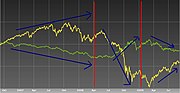
The MSCI Earth Alphabetize of Equities fell while the U.s.a. dollar index rose
Hazard aversion is a kind of trading behavior exhibited past the foreign exchange market when a potentially agin effect happens that may affect market conditions. This beliefs is caused when risk averse traders liquidate their positions in risky assets and shift the funds to less risky assets due to uncertainty.[84]
In the context of the foreign exchange market, traders liquidate their positions in various currencies to accept up positions in safe-oasis currencies, such as the US dollar.[85] Sometimes, the choice of a condom haven currency is more of a choice based on prevailing sentiments rather than i of economic statistics. An example would be the fiscal crisis of 2008. The value of equities beyond the globe fell while the US dollar strengthened (see Fig.1). This happened despite the strong focus of the crisis in the U.s.a..[86]
Carry trade
Currency carry trade refers to the act of borrowing one currency that has a depression interest rate in order to purchase some other with a higher involvement rate. A big difference in rates can be highly assisting for the trader, specially if high leverage is used. However, with all levered investments this is a double edged sword, and large commutation rate price fluctuations tin all of a sudden swing trades into huge losses.
Run into also
- Balance of merchandise
- Currency codes
- Currency strength
- Foreign currency mortgage
- Strange exchange controls
- Foreign exchange derivative
- Strange substitution hedge
- Foreign-exchange reserves
- Leads and lags
- Money market
- Nonfarm payrolls
- Tobin tax
- World currency
Notes
- ^ The total sum is 200% considering each currency trade ever involves a currency pair; one currency is sold (e.g. The states$) and some other bought (€). Therefore each merchandise is counted twice, once nether the sold currency ($) and once under the bought currency (€). The percentages higher up are the percentage of trades involving that currency regardless of whether it is bought or sold, due east.yard. the U.Southward. Dollar is bought or sold in 88% of all trades, whereas the Euro is bought or sold 32% of the time.
References
- ^ Record, Neil, Currency Overlay (Wiley Finance Series)
- ^ Global imbalances and destabilizing speculation (2007), UNCTAD Merchandise and evolution report 2007 (Chapter 1B).
- ^ a b c "Triennial Central Bank Survey of foreign exchange and OTC derivatives markets in 2016".
- ^ CR Geisst – Encyclopedia of American Business History Infobase Publishing, 1 January 2009 Retrieved 14 July 2012 ISBN 1438109873
- ^ GW Bromiley – International Standard Bible Encyclopedia: A–D William B. Eerdmans Publishing Company, 13 Feb 1995 Retrieved fourteen July 2012 ISBN 0802837816
- ^ T Crump – The Phenomenon of Money (Routledge Revivals) Taylor & Francis US, 14 January 2011 Retrieved 14 July 2012 ISBN 0415611873
- ^ J Hasebroek – Trade and Politics in Aboriginal Greece Biblo & Tannen Publishers, 1 March 1933 Retrieved 14 July 2012 ISBN 0819601500
- ^ Due south von Reden (2007 Senior Lecturer in Ancient History and Classics at the Academy of Bristol, UK) - Money in Ptolemaic Egypt: From the Macedonian Conquest to the End of the Tertiary Century BC (p.48) Cambridge University Press, 6 December 2007 ISBN 0521852641 [Retrieved 25 March 2015]
- ^ Mark Cartwright. "Trade in Aboriginal Greece". World History Encyclopedia.
- ^ RC Smith, I Walter, G DeLong – Global Banking Oxford Academy Press, 17 January 2012 Retrieved 13 July 2012 ISBN 0195335937
- ^ (tertiary) – G Vasari – The Lives of the Artists Retrieved 13 July 2012 ISBN 019283410X
- ^ (page 130 of ) Raymond de Roover – The Ascension and Decline of the Medici Bank: 1397–94 Beard Books, 1999 Retrieved 14 July 2012 ISBN 1893122328
- ^ RA De Roover – The Medici Banking company: its organization, management, operations and decline New York University Press, 1948 Retrieved 14 July 2012
- ^ Cambridge dictionaries online – "nostro account"
- ^ Oxford dictionaries online – "nostro account"
- ^ S Homer, Richard Due east Sylla A History of Interest Rates John Wiley & Sons, 29 August 2005 Retrieved xiv July 2012 ISBN 0471732834
- ^ T Southcliffe Ashton – An Economical History of England: The 18th Century, Volume iii Taylor & Francis, 1955 Retrieved 13 July 2012
- ^ (page 196 of) JW Markham A Financial History of the United States, Volumes ane–2 M.East. Sharpe, 2002 Retrieved 14 July 2012 ISBN 0765607301
- ^ (page 847) of M Pohl, European Association for Banking History – Handbook on the History of European Banks Edward Elgar Publishing, 1994 Retrieved 14 July 2012
- ^ (secondary) – [1] Retrieved 13 July 2012
- ^ S Shamah – A Foreign Exchange Primer ["1880" is within ane.2 Value Terms] John Wiley & Sons, 22 November 2011 Retrieved 27 July 2102 ISBN 1119994896
- ^ T Hong – Foreign Exchange Command in China: First Edition (Asia Business Law Serial Volume four) Kluwer Law International, 2004 ISBN 9041124268 Retrieved 12 January 2013
- ^ P Mathias, S Pollard – The Cambridge Economical History of Europe: The industrial economies : the development of economic and social policies Cambridge Academy Printing, 1989 Retrieved xiii July 2012 ISBN 0521225043
- ^ S Misra, PK Yadav [2] – International Business: Text And Cases PHI Learning Pvt. Ltd. 2009 Retrieved 27 July 2012 ISBN 8120336526
- ^ P. L. Cottrell – Centres and Peripheries in Cyberbanking: The Historical Development of Financial Markets Ashgate Publishing, Ltd., 2007 Retrieved 13 July 2012 ISBN 0754661210
- ^ P. Fifty. Cottrell (p. 75)
- ^ J Wake – Kleinwort, Benson: The History of Two Families in Banking Oxford University Press, 27 February 1997 Retrieved thirteen July 2012 ISBN 0198282990
- ^ J Atkin – The Foreign Exchange Market Of London: Development Since 1900 Psychology Press, 2005 Retrieved 13 July 2012 ISBN 041534901X
- ^ Laurence Southward. Copeland – Exchange Rates and International Finance Pearson Education, 2008 Retrieved 15 July 2012 ISBN 0273710273
- ^ M Sumiya – A History of Japanese Merchandise and Industry Policy Oxford University Printing, 2000 Retrieved 13 July 2012 ISBN 0198292511
- ^ RC Smith, I Walter, Yard DeLong (p.4)
- ^ AH Meltzer – A History of the Federal Reserve, Volume ii, Book one; Books 1951–1969 Academy of Chicago Press, one Feb 2010 Retrieved xiv July 2012 ISBN 0226520013
- ^ (folio vii "stock-still exchange rates" of) DF DeRosa –Options on Foreign Exchange Retrieved xv July 2012
- ^ K Butcher – Forex Made Simple: A Beginner'due south Guide to Foreign Commutation Success John Wiley and Sons, 18 February 2011 Retrieved thirteen July 2012 ISBN 0730375250
- ^ J Madura – International Fiscal Management, Cengage Learning, 12 October 2011 Retrieved 14 July 2012 ISBN 0538482966
- ^ N DraKoln – Forex for Minor Speculators Enlightened Financial Press, 1 April 2004 Retrieved xiii July 2012 ISBN 0966624580
- ^ SFO Magazine, RR Wasendorf, Jr.) (INT) – Forex Trading PA Rosenstreich – The Evolution of FX and Emerging Markets Traders Press, 30 June 2009 Retrieved 13 July 2012 ISBN 1934354104
- ^ J Jagerson, SW Hansen – All About Forex Trading McGraw-Hill Professional, 17 June 2011 Retrieved 13 July 2012 ISBN 007176822X
- ^ Franz Pick Option's currency yearbook 1977 – Retrieved 15 July 2012
- ^ page 70 of Swoboda →
- ^ G Gandolfo – International Finance and Open up-Economic system Macroeconomics Springer, 2002 Retrieved 15 July 2012 ISBN 3540434593
- ^ City of London: The History Random Firm, 31 Dec 2011 Retrieved fifteen July 2012 ISBN 1448114721
- ^ "Thursday was aborted by news of a tape assault on the dollar that forced the closing of well-nigh foreign commutation markets." in The outlook: Book 45, published by Standard and Poor's Corporation – 1972 – Retrieved 15 July 2012 → [3]
- ^ H Giersch, K-H Paqué, H Schmieding – The Fading Miracle: 4 Decades of Market Economy in Federal republic of germany Cambridge University Printing, 10 November 1994 Retrieved 15 July 2012 ISBN 0521358698
- ^ International Center for Monetary and Banking Studies, AK Swoboda – Capital Movements and Their Control: Proceedings of the Second Conference of the International Center for Monetary and Cyberbanking Studies BRILL, 1976 Retrieved 15 July 2012 ISBN 902860295X
- ^ ( -p. 332 of ) MR Brawley – Power, Money, And Merchandise: Decisions That Shape Global Economic Relations University of Toronto Printing, 2005 Retrieved 15 July 2012 ISBN 1551116839
- ^ "... forced to close for several days in mid-1972, ... The foreign exchange markets were airtight again on two occasions at the kickoff of 1973,.. " in H-J Rüstow New paths to total employment: the failure of orthodox economic theory Macmillan, 1991 Retrieved 15 July 2012 → [four]
- ^ Chen, James (2009). Essentials of Foreign Substitution Trading. ISBN0470464003 . Retrieved 15 November 2016.
- ^ Hicks, Alan (2000). Managing Currency Risk Using Foreign Exchange Options. ISBN1855734915 . Retrieved 15 November 2016.
- ^ Johnson, G. G. (1985). Conception of Commutation Charge per unit Policies in Adjustment Programs. ISBN0939934507 . Retrieved fifteen Nov 2016.
- ^ JA Dorn – China in the New Millennium: Market Reforms and Social Evolution Cato Found, 1998 Retrieved fourteen July 2012 ISBN 1882577612
- ^ B Laurens, H Mehran, Yard Quintyn, T Nordman – Monetary and Exchange System Reforms in People's republic of china: An Experiment in Gradualism International Monetary Fund, 26 September 1996 Retrieved fourteen July 2012 ISBN 1452766126
- ^ Y-I Chung – South Korea in the Fast Lane: Economic Development and Capital letter Germination Oxford University Press, 20 July 2007 Retrieved fourteen July 2012 ISBN 0195325451
- ^ KM Dominguez, JA Frankel – Does Foreign Exchange Intervention Work? Peterson Institute for International Economics, 1993 Retrieved xiv July 2012 ISBN 0881321044
- ^ (page 211 – [source BIS 2007]) H Van Den Berg – International Finance and Open-Economic system Macroeconomics: Theory, History, and Policy World Scientific, 31 Baronial 2010 Retrieved xiv July 2012 ISBN 9814293512
- ^ PJ Quirk Issues in International Exchange and Payments Systems International Budgetary Fund, xiii April 1995 Retrieved xiv July 2012 ISBN 1557754802
- ^ "Written report on global foreign exchange market action in 2013" (PDF). Triennial Central Bank Survey. Basel, Switzerland: Bank for International Settlements. September 2013. p. 12. Retrieved 22 October 2013.
- ^ "Derivatives in emerging markets", the Bank for International Settlements, xiii December 2010
- ^ "The $4 trillion question: what explains FX growth since the 2007 survey? , the Banking concern for International Settlements, 13 December 2010
- ^ Lilley, Marking. "Euromoney FX Survey 2020 – results released".
- ^ "Triennial Central Bank Survey Foreign substitution turnover in April 2016" (PDF). Triennial Central Bank Survey. Basel, Switzerland: Depository financial institution for International Settlements. September 2016. Retrieved 1 September 2016.
- ^ Gabriele Galati, Michael Melvin (December 2004). "Why has FX trading surged? Explaining the 2004 triennial survey" (PDF). Bank for International Settlements.
- ^ Alan Greenspan, The Roots of the Mortgage Crisis: Bubbles cannot be safely defused by monetary policy before the speculative fever breaks on its own. , the Wall Street Periodical, 12 December 2007
- ^ McKay, Peter A. (26 July 2005). "Scammers Operating on Periphery Of CFTC'south Domain Lure Little Guy With Fantastic Promises of Profits". The Wall Street Journal. Retrieved 31 October 2007.
- ^ Egan, Jack (19 June 2005). "Check the Currency Risk. And so Multiply by 100". The New York Times . Retrieved 30 Oct 2007.
- ^ The Lord's day Times (London), 16 July 2006
- ^ Andy Kollmorgen. "Overseas money transfers". choice.com.au.
- ^ "Info" (PDF). www.pondiuni.edu.in.
- ^ "Data" (PDF). nptel.ac.in.
- ^ "Triennial Central Bank Survey Strange exchange turnover in April 2019" (PDF). Bank for International Settlements. 16 September 2019. p. 10. Retrieved xvi September 2019.
- ^ The Microstructure Approach to Exchange Rates, Richard Lyons, MIT Press (pdf chapter i)
- ^ "To What Extent Does Productivity Drive the Dollar?" (PDF). SSRN 711362.
- ^ "Safe Haven Currency". Financial Glossary. Reuters. Archived from the original on 27 June 2013. Retrieved 22 April 2013.
- ^ John J. Potato, Technical Analysis of the Financial Markets (New York Institute of Finance, 1999), pp. 343–375.
- ^ "Overbought". Investopedia. Retrieved 22 Apr 2013.
- ^ Sam Y. Cantankerous, All Almost the Foreign Exchange Market in the United States, Federal Reserve Bank of New York (1998), chapter 11, pp. 113–115.
- ^ Gelet, Joseph (2016). Splitting Pennies. Elite East Services. ISBN 9781533331090.
- ^ Arlie O. Petters; Xiaoying Dong (17 June 2016). An Introduction to Mathematical Finance with Applications: Agreement and Edifice Fiscal Intuition. Springer. pp. 345–. ISBN978-1-4939-3783-vii.
- ^ Michael A. S. Guth, "Profitable Destabilizing Speculation," Chapter i in Michael A. S. Guth, Speculative beliefs and the operation of competitive markets under dubiousness, Avebury Ashgate Publishing, Aldorshot, England (1994), ISBN 1-85628-985-0.
- ^ What I Learned at the World Economic Crunch Joseph Stiglitz, The New Republic, 17 April 2000, reprinted at GlobalPolicy.org
- ^ Lawrence Summers and Summers VP (1989) 'When financial markets work likewise well: a Cautious case for a securities transaction tax' Periodical of fiscal services
- ^ Redburn, Tom (17 September 1992). "But Don't Blitz Out to Buy Kronor: Sweden's 500% Take a chance". The New York Times . Retrieved 18 April 2015.
- ^ Gregory J. Millman, Around the Globe on a Trillion Dollars a Day, Bantam Printing, New York, 1995.
- ^ "Risk Averse". Investopedia. Retrieved 25 February 2010.
- ^ Moon, Angela (five February 2010). "Global markets – Us stocks rebound, dollar gains on chance aversion". Reuters. Retrieved 27 February 2010.
- ^ Stewart, Heather (ix Apr 2008). "IMF says US crisis is 'largest financial shock since Bang-up Depression'". The Guardian. London. Retrieved 27 February 2010.
External links
- A user's guide to the Triennial Central Bank Survey of strange exchange marketplace activity, Depository financial institution for International Settlements
- London Foreign Exchange Committee with links (on right) to committees in NY, Tokyo, Canada, Australia, HK, Singapore
- United States Federal Reserve daily update of exchange rates
- Banking company of Canada historical (x-yr) currency converter and data download
- OECD Exchange rate statistics (monthly averages)
- National Futures Association (2010). Trading in the Retail Off-Exchange Strange Currency Market place. Chicago, Illinois.
- Forex Resources at Curlie

Source: https://en.wikipedia.org/wiki/Foreign_exchange_market
Posted by: johnsonthoures.blogspot.com
0 Response to "History Of The Forex Market How It All Began"
Post a Comment