

free white label binary options
Introduction
For some reason, Regression and Classification problems end upwards taking most of the attention in automobile learning globe. People don't realize the wide multifariousness of machine learning bug which tin can exist.
I, on the other hand, love exploring different multifariousness of problems and sharing my learning with the community hither.
Previously, I shared my learnings on Genetic algorithms with the customs. Continuing on with my search, I intend to cover a topic which has much less widespread but a nagging problem in the data scientific discipline community – which is multi-label classification.
In this article, I will give you an intuitive explanation of what multi-label classification entails, along with illustration of how to solve the trouble. I promise it will show you the horizon of what data science encompasses. So lets get on with information technology!
Tabular array of Contents
- What is Multi-Label Classification?
- Multi-Class v/due south Multi-Characterization
- Loading and Generating Multi-Label Datasets
- Techniques for Solving a Multi-Characterization Classification Problem
- Problem Transformation Method
- Adapted Algorithm Method
- Ensemble Approaches
- Case studies
1. What is Multi-Label Classification?
Permit us take a await at the epitome below.

What if I ask you that does this prototype contains a firm? The option will be Yes or NO.
Consider another case, like what all things (or labels) are relevant to this picture?

These types of bug, where nosotros have a set of target variables, are known every bitmulti-label classification problems. And then, is there any difference between these two cases? Clearly, yeah because in the 2nd case any image may contain a different set of these multiple labels for different images.
But earlier going deep into multi-label, I just wanted to articulate one matter every bit many of you might exist confused that how this is different from the multi-class problem.
And then, allow's us endeavor to sympathise the difference between these ii sets of problems.
ii. Multi-Label five/due south Multi-Class
Consider an case to understand the departure between these two. For this, I promise that below image makes things quite clear. Let'southward try to understand it.
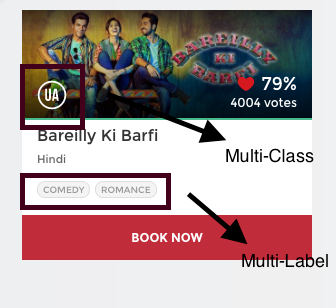
For any flick, Central Board of Picture show Certification, issue a document depending on the contents of the motion-picture show.
For example, if you look above, this movie has been rated equally 'U/A' (meaning 'Parental Guidance for children below the historic period of 12 years' ) certificate. In that location are other types of certificates classes like 'A' (Restricted to adults) or 'U' (Unrestricted Public Exhibition) , but it is sure that each picture tin merely be categorized with only one out of those three type of certificates.
In brusk, there are multiple categories only each case is assigned but 1, therefore such problems are known equally multi-form nomenclature trouble.
Once more, if you await back at the image, this movie has been categorized into comedy and romance genre. But in that location is a divergence that this time each picture show could fall into 1 or more than different sets of categories.
Therefore, each instance can be assigned with multiple categories, so these types of bug are known as multi-label classification problem, where we have a prepare of target labels.
Peachy! Now yous can distinguish between a multi-label and multi-class problem. And then, allow's start how to deal with these types of problems.
3. Loading and Generating Multi-Characterization Datasets
Scikit-learn has provided a separate library scikit-multilearn for multi label classification.
For better agreement, allow us kickoff practicing on a multi-characterization dataset. You lot tin can notice a real-world data set from the repository provided by MULAN package. These datasets are nowadays in ARFF format.
So, for getting started with any of these datasets, look at the python code below for loading it onto your jupyter notebook. Hither I have downloaded the yeast data set from the repository.
import scipy from scipy.io import arff data, meta = scipy.io.arff.loadarff('/Users/shubhamjain/Documents/yeast/yeast-train.arff') df = pd.DataFrame(data) There is how the data set looks like.
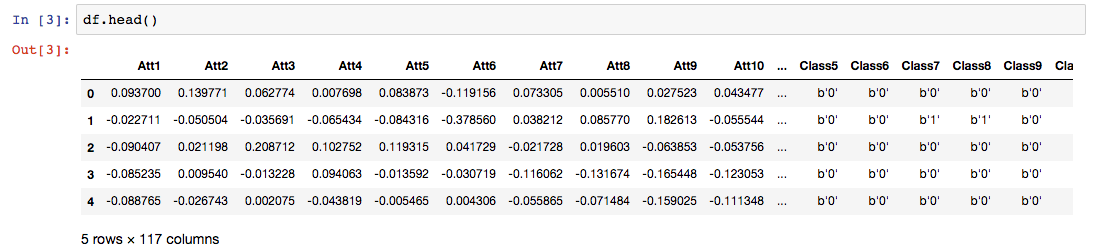
Here, Att represents the attributes or the contained variables and Class represents the target variables.
For practise purpose, nosotros have another option to generate an artificial multi-characterization dataset.
from sklearn.datasets import make_multilabel_classification # this will generate a random multi-label dataset X, y = make_multilabel_classification(thin = True, n_labels = twenty, return_indicator = 'sparse', allow_unlabeled = False)
Let u.s.a. understand the parameters used above.
sparse : If True, returns a sparse matrix, where sparse matrix ways a matrix having a big number of zero elements.
n_labels : The average number of labels for each instance.
return_indicator : If 'sparse' return Y in the sparse binary indicator format.
allow_unlabeled : If Truthful , some instances might not belong to any course.
You must have noticed that we have used sparse matrix everywhere, and scikit-multilearn too recommends to use data in the sparse form considering it is very rare for a real-world data set to be dumbo. Generally, the number of labels assigned to each instance is very less.
Okay, now we have our datasets ready so permit us quickly learn the techniques to solve a multi-characterization problem.
4. Techniques for Solving a Multi-Characterization nomenclature problem
Basically, there are iii methods to solve a multi-characterization classification problem, namely:
- Trouble Transformation
- Adapted Algorithm
- Ensemble approaches
4.1 Problem Transformation
In this method, we will effort to transform our multi-label problem into single-label problem(s).
This method can be carried out in three different ways as:
- Binary Relevance
- Classifier Chains
- Characterization Powerset
4.1.1 Binary Relevance
This is the simplest technique, which basically treats each label as a separate single grade classification problem.
For example, let us consider a case as shown below. We have the data set like this, where X is the contained feature and Y'southward are the target variable.
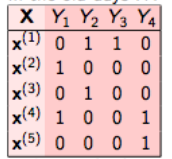
In binary relevance, this problem is broken into 4 different single form classification bug as shown in the effigy below.
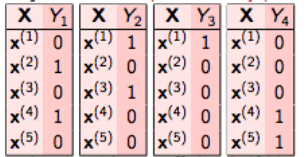
We don't have to do this manually, the multi-larn library provides its implementation in python. So, allow's us speedily expect at its implementation on the randomly generated information.
# using binary relevance from skmultilearn.problem_transform import BinaryRelevance from sklearn.naive_bayes import GaussianNB # initialize binary relevance multi-label classifier # with a gaussian naive bayes base classifier classifier = BinaryRelevance(GaussianNB()) # train classifier.fit(X_train, y_train) # predict predictions = classifier.predict(X_test)
NOTE: Here, we accept used Naive Bayes algorithm but y'all can use any other classification algorithm.
Now, in a multi-characterization classification problem, nosotros tin can't simply employ our normal metrics to calculate the accuracy of our predictions. For that purpose, we will use accuracy score metric. This function calculates subset accuracy pregnant the predicted set of labels should exactly lucifer with the true gear up of labels.
So, let united states of america calculate the accuracy of the predictions.
from sklearn.metrics import accuracy_score accuracy_score(y_test,predictions)
So, we have attained an accuracy score of 45%, which is not as well bad. Let'south us apace look at its pros and cons.
Information technology is most simple and efficient method merely the only drawback of this method is that it doesn't consider labels correlation because it treats every target variable independently.
4.1.2 Classifier Chains
In this, the first classifier is trained but on the input data and and so each next classifier is trained on the input infinite and all the previous classifiers in the chain.
Let'south try to this sympathize this by an example. In the dataset given below, we have Ten every bit the input space and Y's equally the labels.
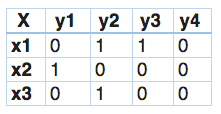
In classifier bondage, this problem would be transformed into iv unlike single label problems, just like shown beneath. Here xanthous colored is the input space and the white part represent the target variable.

This is quite like to binary relevance, the merely difference being information technology forms bondage in order to preserve label correlation. So, let'south try to implement this using multi-acquire library.
# using classifier chains from skmultilearn.problem_transform import ClassifierChain from sklearn.naive_bayes import GaussianNB # initialize classifier bondage multi-characterization classifier # with a gaussian naive bayes base classifier classifier = ClassifierChain(GaussianNB()) # train classifier.fit(X_train, y_train) # predict predictions = classifier.predict(X_test) accuracy_score(y_test,predictions)
0.21212121212121213
Nosotros can meet that using this we obtained an accuracy of most 21%, which is very less than binary relevance. This is peradventure due to the absence of label correlation since we have randomly generated the data.
4.1.3 Label Powerset
In this, we transform the trouble into a multi-class problem with one multi-class classifier is trained on all unique label combinations institute in the preparation data.
Let's understand it past an case.
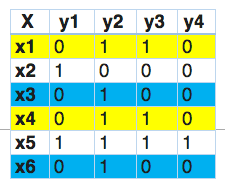
In this, we find that x1 and x4 have the same labels, similarly, x3 and x6 accept the same set of labels. Then, characterization powerset transforms this problem into a single multi-class problem as shown below.
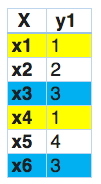
So, label powerset has given a unique class to every possible characterization combination that is present in the preparation set up.
Permit's us expect at its implementation in python.
# using Characterization Powerset from skmultilearn.problem_transform import LabelPowerset from sklearn.naive_bayes import GaussianNB # initialize Label Powerset multi-label classifier # with a gaussian naive bayes base of operations classifier classifier = LabelPowerset(GaussianNB()) # train classifier.fit(X_train, y_train) # predict predictions = classifier.predict(X_test) accuracy_score(y_test,predictions)
0.5757575757575758
This gives us the highest accuracy among all the three we have discussed till at present. The only disadvantage of this is that every bit the training information increases, number of classes become more than. Thus, increasing the model complication, and would result in a lower accuracy.
Now, let us expect at the second method to solve multi-label nomenclature problem.
iv.2 Adapted Algorithm
Adapted algorithm, as the name suggests, adapting the algorithm to directly perform multi-characterization classification, rather than transforming the problem into different subsets of bug.
For example, multi-characterization version of kNN is represented by MLkNN. And so, let us quickly implement this on our randomly generated data ready.
from skmultilearn.adapt import MLkNN classifier = MLkNN(k=twenty) # train classifier.fit(X_train, y_train) # predict predictions = classifier.predict(X_test) accuracy_score(y_test,predictions)
0.69
Great! You have achieved an accuracy score of 69% on your test data.
Sci-kit learn provides inbuilt back up of multi-label nomenclature in some of the algorithm similar Random Woods and Ridge regression. And then, yous can directly phone call them and predict the output.
You tin can bank check the multi-larn library if you lot wish to acquire more nearly other types of adapted algorithm.
four.3 Ensemble Approaches
Ensemble always produces better results. Scikit-Multilearn library provides dissimilar ensembling classification functions, which you lot can employ for obtaining better results.
For the directly implementation, yous can cheque out hither .
5. Case Studies
Multi-characterization classification problems are very common in the real world. So, let u.s. wait at some of the areas where nosotros can observe the use of them.
i. Audio Categorization
We accept already seen songs existence classified into unlike genres. They are also been classified on the basis of emotions or moods like "relaxing-calm", or "deplorable-lonely" etc.
Source: link
2. Paradigm Categorization
Multi-label classification using prototype has also a wide range of applications. Images can be labeled to betoken different objects, people or concepts.

3. Bioinformatics
Multi-Label nomenclature has a lot of use in the field of bioinformatics, for case, classification of genes in the yeast data fix.
Information technology is also used to predict multiple functions of proteins using several unlabeled proteins. You can cheque this paper for more than data.
4. Text Categorization
You all must once check out google news. And so, what google news does is, it labels every news to 1 or more categories such that information technology is displayed under different categories. For example, accept a expect at the image beneath.

Image source: Google news
That same news is present nether the categories of Republic of india, Applied science, Latest etc. because it has been classified into these different labels. Thus making it a multi label classification problem.
There are plenty of other areas, so explore and comment down below if you lot wish to share it with the community.
half dozen. End Notes
In this commodity, I introduced yous to the concept of multi-label classification bug. I have also covered the approaches to solve this trouble and the practical utilise cases where you may have to handle information technology using multi-learn library in python.
I hope this commodity will requite you a caput starting time when you lot face these kinds of problems. If you lot have any doubts/suggestions, experience free to reach out to me below!

Source: https://www.analyticsvidhya.com/blog/2017/08/introduction-to-multi-label-classification/
Posted by: johnsonthoures.blogspot.com
0 Response to "free white label binary options"
Post a Comment